How Nighthawk Router OFDMA Scheduling Improves Network Efficiency When Multiple Devices Compete for Bandwidth in 2026
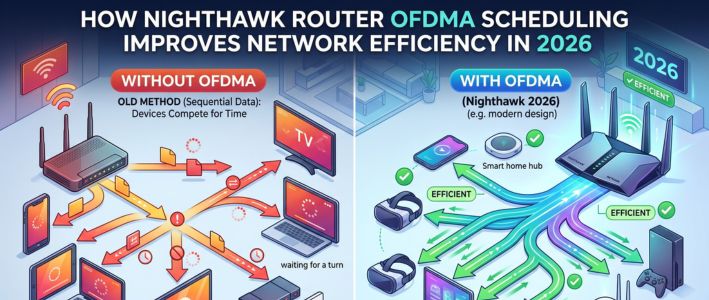
Modern homes can have dozens of connected devices operating at the same time. Smartphones, laptops, smart TVs, gaming consoles, security cameras, smart speakers, tablets, and connected appliances all compete for wireless network resources. When many devices transmit data simultaneously, inefficient communication can increase latency and reduce the overall responsiveness of the network.
OFDMA, or Orthogonal Frequency Division Multiple Access, is one of the technologies used in modern WiFi standards to improve how wireless resources are shared among multiple devices. Compatible Nighthawk routers can use OFDMA scheduling to divide available wireless resources into smaller portions, allowing multiple devices to communicate more efficiently.
For homeowners managing their network, completing a proper netgear nighthawk setup can help ensure compatible networking features are configured correctly. The netgear nighthawk app can also provide a convenient way to manage supported Nighthawk systems and monitor connected devices.
What Is OFDMA?
OFDMA stands for Orthogonal Frequency Division Multiple Access.
Traditional wireless communication can require devices to wait for opportunities to transmit data. OFDMA improves this process by dividing a wireless channel into smaller resource units that can be allocated to multiple devices.
Instead of treating the entire channel as one communication opportunity, compatible WiFi systems can distribute portions of the available spectrum among different clients.
This can improve efficiency when many devices have data to send.
Why Multiple Devices Can Create Network Congestion
A modern household may connect:
- Smartphones
- Laptops
- Smart TVs
- Gaming consoles
- Security cameras
- Smart thermostats
- Streaming devices
- Smart speakers
- Tablets
Not every device requires the same amount of bandwidth. For example, a smart sensor may transmit only a small amount of information, while a 4K streaming device can require significantly more sustained bandwidth.
Without efficient scheduling, small data transmissions can contribute to unnecessary network overhead.
How OFDMA Scheduling Works
OFDMA allows a compatible router to divide a wireless channel into smaller resource units. The router can then schedule multiple client devices to use different portions of the channel during a transmission opportunity.
This approach can help:
- Reduce unnecessary waiting
- Improve spectrum utilization
- Handle small data transmissions efficiently
- Reduce communication overhead
- Improve network responsiveness
The exact behavior depends on the router model, connected devices, WiFi standard, firmware, and network environment.
OFDMA and WiFi Efficiency
Wireless networks have limited spectrum available for communication. OFDMA helps use that spectrum more efficiently by allowing multiple compatible devices to share resources within a transmission opportunity.
This can be especially useful in homes where many devices frequently exchange relatively small amounts of data.
For example, smart home sensors may periodically send status information. OFDMA can help manage these smaller transmissions without requiring every device to compete for the entire channel independently.
Benefits for Smart Homes
Smart homes are a particularly useful environment for technologies such as OFDMA. A connected home may have:
- Door sensors
- Security cameras
- Smart lights
- Voice assistants
- Thermostats
- Appliances
- Smart locks
Many of these devices transmit small amounts of data but may operate simultaneously. More efficient scheduling can help the wireless network manage this diverse traffic more effectively.
Improving Network Responsiveness
Network performance is not determined only by maximum download speed. Responsiveness also depends on factors such as:
- Latency
- Congestion
- Wireless interference
- Device capability
- Signal strength
- Network traffic patterns
OFDMA can improve wireless efficiency under suitable conditions, potentially helping the network remain more responsive when multiple compatible devices are active.
OFDMA and Online Gaming
Gaming applications can be sensitive to latency and network interruptions. A gaming console may compete with streaming devices, smartphones, computers, and smart home equipment for wireless resources.
OFDMA scheduling can help compatible devices share wireless resources more efficiently. However, OFDMA does not guarantee lower ping in every situation. Internet service quality, server distance, router placement, interference, and gaming platform performance also influence latency.
Supporting Video Streaming
High-resolution streaming can consume significant bandwidth. When multiple household members stream video simultaneously, wireless network demand increases.
A modern Nighthawk router with compatible WiFi features can help manage wireless traffic more efficiently.
OFDMA can be particularly useful when high-bandwidth devices operate alongside many lower-bandwidth smart devices.
Importance of Compatible Client Devices
OFDMA benefits depend partly on client-device compatibility.
A router may support advanced WiFi features, but older wireless devices may not take full advantage of them.
For the best results, users should consider:
- Router capabilities
- Client WiFi generation
- Firmware versions
- Wireless drivers
- Channel conditions
Updating compatible devices can help ensure they work correctly with modern networking technologies.
Proper Nighthawk Router Setup
A correct netgear nighthawk setup is an important starting point for reliable network performance. During setup, users should pay attention to:
- Router placement
- Wireless configuration
- Firmware updates
- Security settings
- Network names
- Password configuration
- Connected device compatibility
The router should ideally be positioned in an open and central location to improve wireless coverage.
Managing the Network With the Nighthawk App
The netgear nighthawk app can simplify management of supported Nighthawk networking products.
Depending on the router and available features, users may be able to:
- Complete network setup
- Monitor connected devices
- Run speed tests
- Manage wireless settings
- Configure security features
- View network information
- Manage supported parental controls
Keeping the app and router firmware updated can also help users access current supported functionality.
OFDMA Compared With Traditional Wireless Scheduling
Traditional wireless communication can require devices to compete for opportunities to transmit. OFDMA changes this approach by allowing the router to allocate smaller resource units to multiple compatible clients.
This can reduce inefficiencies associated with handling many small transmissions.
The technology is therefore particularly relevant to environments where numerous devices communicate simultaneously.
OFDMA Is Not a Replacement for Fast Internet
It is important to understand that OFDMA improves wireless resource efficiency; it does not increase the speed supplied by an internet service provider.
If a household has a slow internet connection, OFDMA cannot transform it into a high-speed connection.
Other factors remain important, including:
- Internet plan speed
- Router hardware
- WiFi generation
- Signal strength
- Interference
- Ethernet infrastructure
- Client-device capabilities
Future of Wireless Scheduling
Wireless networking continues to become more intelligent. Future networking technologies are expected to incorporate:
- More advanced scheduling
- AI-assisted traffic management
- Dynamic spectrum allocation
- Automated interference detection
- Intelligent device prioritization
- Multi-link communication
These developments could make home networks increasingly capable of managing large numbers of connected devices.
Final Thoughts
Nighthawk router OFDMA scheduling can improve wireless network efficiency by allowing compatible devices to share wireless resources more intelligently. This becomes increasingly valuable in 2026 as homes continue adding smartphones, computers, smart appliances, cameras, gaming systems, and streaming devices.
A properly completed netgear nighthawk setup provides an important foundation for reliable wireless performance, while the netgear nighthawk app can make supported network management and monitoring more convenient.
OFDMA is not a solution for every networking problem, and its benefits depend on compatible hardware, suitable WiFi standards, signal conditions, firmware, and overall network configuration. However, when these elements work together, OFDMA scheduling can help modern home networks handle multiple competing devices more efficiently and maintain a more responsive wireless experience.
Frequently Asked Questions
What is OFDMA in a Nighthawk router?
OFDMA is a wireless technology that divides a WiFi channel into smaller resource units, allowing compatible devices to share wireless transmission opportunities more efficiently.
Does OFDMA increase internet speed?
OFDMA primarily improves wireless resource efficiency. It does not increase the internet speed provided by an internet service provider.
Why is OFDMA useful when many devices are connected?
It can help a compatible router manage multiple client transmissions more efficiently, particularly when numerous devices are sending smaller amounts of data.
Does every device need to support OFDMA?
The router and client device need compatible support to take full advantage of OFDMA-related features. Older devices may not benefit from every advanced WiFi capability.
How does netgear nighthawk setup affect wireless performance?
A proper netgear nighthawk setup, including suitable router placement, updated firmware, appropriate security settings, and correct wireless configuration, can provide a strong foundation for network performance.
What can I do with the netgear nighthawk app?
setup, connected-device monitoring, speed testing, and other controls depending on the specific Nighthawk model.